Quantum Random Number Generation
February – June 2025
Conducted experimental research on quantum entanglement using a QuED platform. Designed Bell (CHSH) inequality experiments, analyzed experimental measurements, and validated quantum correlations against theoretical models. Developed data visualization tools and investigated real-world applications of quantum technologies, particularly quantum cryptography (QKD).
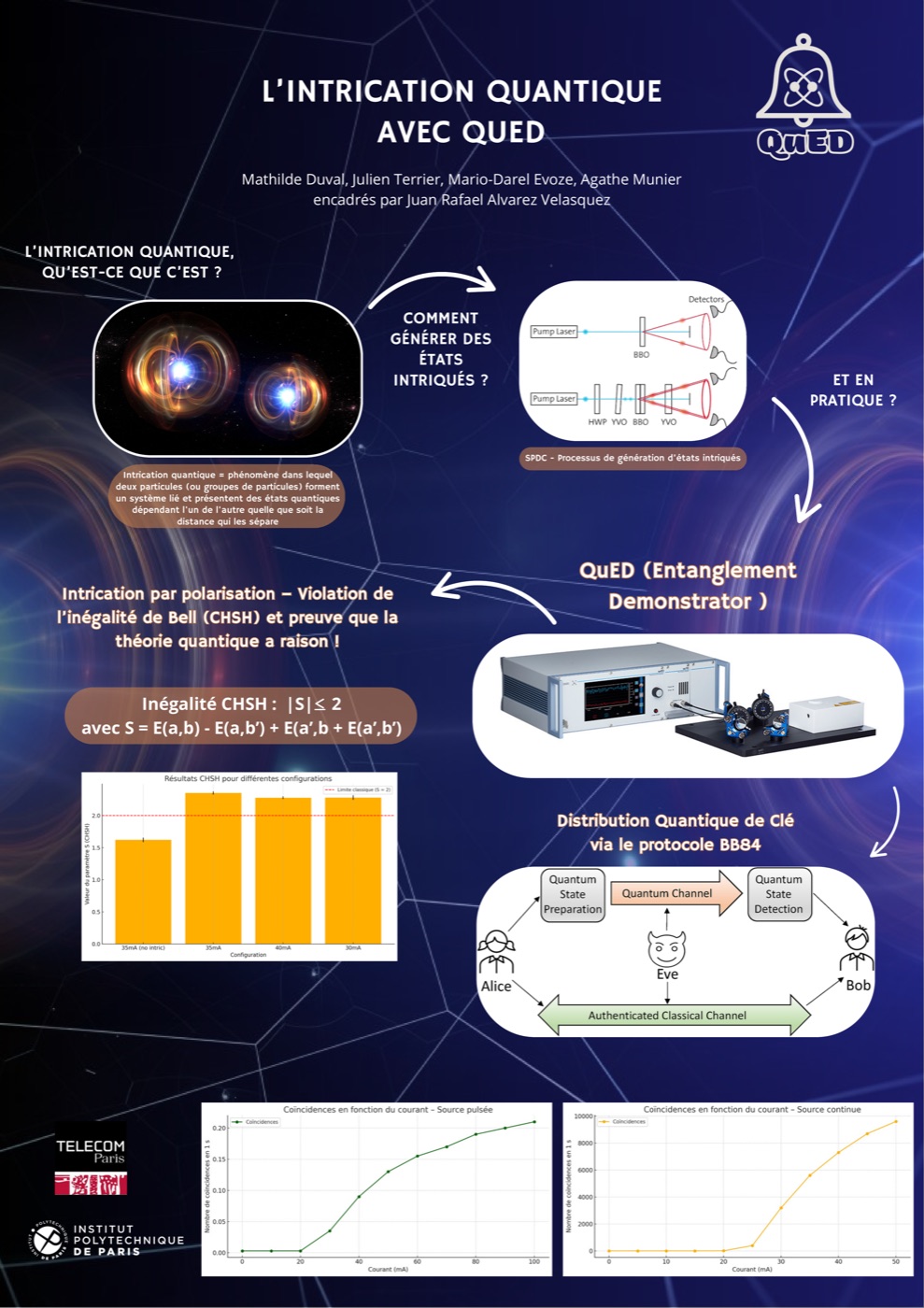
How entangled photons are generated
The QuED platform produces entangled photon pairs by spontaneous parametric down-conversion (SPDC): a pump laser is sent through nonlinear BBO crystals, which occasionally convert one pump photon into two lower-energy photons correlated in polarization. Wave plates (HWP/YVO) tune the resulting entangled state before it reaches the detectors.
Proving it: the CHSH Bell test
Local hidden-variable theories predict a correlation parameter bounded by |S| ≤ 2; quantum mechanics allows up to 2√2 ≈ 2.83. We measured S across several drive-current configurations of the entangled source:
Dashed line marks the classical limit (S = 2). Every configuration with entanglement switched on violates it; the control run without entanglement stays below. Values reproduced from our poster.
Applying it: quantum key distribution (BB84)
Once entanglement was validated, we used the same platform to run the BB84 quantum key distribution protocol: Alice and Bob exchange quantum states over a quantum channel, then compare a subset of their measurement bases over an authenticated classical channel — which lets them detect, rather than merely hope to prevent, the presence of an eavesdropper (Eve). We measured detector coincidence rates as a function of drive current for both a pulsed and a continuous-wave source to characterize the setup before running the protocol.
Team & timeline
With Mathilde Duval, Julien Terrier and Mario-Darel Evoze — supervised by Juan Rafael Alvarez Velasquez, Télécom Paris.
Studied the physics of entangled light (SPDC, BBO crystals, avalanche photodiodes) and the theory behind Bell's inequality, splitting research across the team before touching the hardware.
Got hands-on with the QuED, wrote an experimental protocol, and ran the CHSH measurements above across several source configurations, then packaged the results into a report.
Paired with a neighboring student project generating random numbers from quantum measurements, cross-checking our understanding of the underlying physics with theirs.
Studied the BB84 protocol and adapted our setup to run it end-to-end, measuring coincidence rates for pulsed and continuous sources along the way.